


19 June 2026: ABC report on about-to-be-opened Afghanistan Gallery.
18 June 2026: Rob Harris in Sydney Morning Herald reviews about-to-be-opened Afghanistan Gallery: 'How the new Australian War Memorial gallery captures the unsettled history of the conflict in Afghanistan'.
“Was it worth it?”
It is the question that anchors – and unsettles – the new Afghanistan gallery at the Australian War Memorial, where the answers come not as resolution but as contradiction.
Veterans, Afghan civilians, families and interpreters of a 20-year war are all asked the same thing. The responses diverge sharply. Some speak of meaning, service and gains that endure; others question the premise entirely.
Quotes Memorial officer Bliss Jensen and Director Anderson. Jensen says:
We were very adamant from the beginning that we weren’t to shy away from telling difficult stories. Our many audience surveys and advisory group feedback … all showed us there was a desire to see the difficult content, to be objective, to be balanced, but to go there.
A quick survey
This four-part promo cum doco is slicker and smoother than the Big Build it describes. Producer Serge Ou of Wildbear Entertainment must have accumulated thousands of hours of film to produce the 217 minutes of beautifully photographed final cut.
These good points stand out: the commitment of the Memorial staff, front of house, back of house and in-between, and contractors; the eagerness of veterans to help with the details of displays depicting their service; the segments on peacekeeping in Timor Leste and Rwanda and clearance divers in the Gulf War; Operation Baby Lift out of Vietnam; the opening of the expanded Bean Building research area. There are only a couple of awkward moments (including the Michael Zavros ‘Pistol grip’ portrait of Ben Roberts-Smith being moved into storage) and one rather over-scripted scene (Director Matt Anderson and Executive Director–Development Wayne Hitches strolling across the concrete forecourt at the end of episode 4).
The doco uncovers some notable video stars among the Memorial's workforce. Even Director Anderson looks less nervous than he does in Senate Estimates. The value of rehearsals, perhaps.
The Big Build is front and centre: drone shots showing us the changing structure over four or so years; technical stuff with huge girders and beams, heavy kit, hours of work on a small object, how to make a broken vehicle perch properly on its plinth; lots of problem-solving, lifting Large Technology Objects (LTOs) and fitting them into the new Anzac Hall, glass made in Spain for the Oculus (big skylight re-imagining the Memorial dome) then carefully fitted together, structural columns lifted and lowered again, hinges trimmed off to get vehicles through doors, keeping the Eternal Flame burning, displaying the V2 rocket at an angle (for the ‘wow’ factor, just as if it was pointing at London 1944), and early morning truck journeys carrying big bits of stuff to and from the Memorial’s Treloar Centre at Mitchell and elsewhere.
Most of all inside, there are the cavernous spaces, from the new entrance area, big enough for large dinners, to the Anzac Atrium, where you can stand back and say, ‘Wow’ (that word again) at the LTOs displayed – as Director Anderson proudly claimed every single visitor on Day One did.
Is this really the sort of war service recognition we want?
If this is the sort of War Memorial you expect it is good that the show looks handsome. But is this really the sort of recognition of war service we want? The focus on recent service is perhaps understandable, but the show doesn’t explore the key question whether the $550m (and counting) cost would have been better spent on direct services to today’s veterans.
Napier Waller Art Prize winner and war widow, Kat Rae, does address that issue in episode 1: ‘My artwork speaks to what happens when you spend too much on commemoration and not enough on the living veterans who have put their lives and bodies on the line’. (Kat Rae wrote for Defending Country.)
Which raises questions like whether children are better served by seeing a mock-up of the machine in which their parent was blown up and injured or, on the other hand, seeing them get decent mental health services? If both are happening but the second not enough, surely those services would have benefited from that $550m? Do the Memorial’s state-of-the-art diorama production techniques really matter when the Department of Veterans’ Affairs can’t get its act together?
The Australian Wars are missing
Then there’s that almost ignored subject: the Australian Wars, or what the Memorial has mostly referred to as ‘frontier conflict’, the wars that killed between 20,000 and 100,000 First Australians between 1788 and at least 1928. In the view of Henry Reynolds, Australia’s foremost historian of our frontier, this was ‘our most important war’. (Professor Reynolds is one of Defending Country’s distinguished Patrons.)
In those 217 minutes of A New Anzac, this reviewer tallied less than ten minutes showing Indigenous soldiers in uniform, marching, making a speech, and playing the yidaki. There is a brief segment in episode 1 showing a service at the For Our Country memorial to Indigenous service people, but the name and purpose of the memorial (in the Memorial grounds) is garbled and, more importantly, there is no reference to the deaths of First Nations people not in uniform but in the Australian Wars. A First Nations staff member hopes for a better future for Australia but that he himself is First Nations does not appear in the caption.
In episode 2, the Memorial’s Indigenous Liaison Officer raises the Aboriginal and Torres Strait Islander flag at the front of the Memorial and says this is not only recognition of Aboriginal and Torres Strait Islander service but also ‘a step towards Reconciliation for the broader Australian public’. In episode 2 also, Aunty Lorraine Hatton OAM, the only First Nations member of the Memorial Council (and Indigenous Elder of the Australian Army), shows the King and Queen around the For Our Country memorial and afterwards remarks 'our journey to Reconciliation has been a challenging and difficult path to walk. Aboriginal people have had an unbroken line of defence of country.’
Wildbear, or perhaps Wildbear and the Memorial between them, include only these cautious, ambiguous, passing remarks, relating no more than obliquely to the Australian Wars. We have no idea what else was said but ended up on the editing floor.
Then, right at the end of episode 4, we get this statement: ‘In 2026, a dedicated team will be established to develop the pre-1914 galleries. The development of these new spaces will be guided by advisory groups and First Nations communities. They are planned to open in 2028.’
This is not new news. We already know that, under current plans, the allocation to the Australian Wars (frontier conflict) will be around one per cent of total gallery space after the Memorial redevelopment is completed – and that will be shared with exhibits on the Australian contingents sent to the New Zealand Wars 1845-72 and the Sudan 1885. The reference to advisory groups and First Nations communities is a cop-out; a firm, brave and authoritative decision by the Memorial Council is required - now. That is what the Council is there for.*
Meanwhile, A New Anzac spends much longer on how to achieve the correct degree of ‘crunchiness’ for the Memorial’s parade ground gravel, the technique for laying it, and how to march on it for maximum crunch, than it does (obliquely) on First Nations deaths defending Country. That is beyond incongruous.
This nervous avoiding of the Australian Wars is unlikely to be down to Wildbear alone. The Memorial, particularly at its top levels, still has difficulty with the idea that it should recognise and commemorate blackfellers defending their Country, as well as whitefellers (and some blackfellers in uniform) being sent overseas to fight in other people’s wars. The Memorial is not just for veterans, let alone recent veterans. It is certainly not 'the home of our veterans' as the Director says in episode 1. It is, or should be, a place for all Australians, the descendants of our volunteer service people over a century, the regular ADF members of recent decades, and blackfellers and whitefellers.
Water under the bridge maybe – but should not be forgotten
A New Anzac also leaves out the lobbying that delivered the initial $500m from the Morrison government for the redevelopment, the budgetary shenanigans that concealed for a while the additional $50m sling in that government’s dying days, the shonky process that led to the destruction of the first trees and turning of the first sods, the sustained public opposition to the project, the shameful role of the National Capital Authority, the vain efforts of the Australian Heritage Council and the Environment Department to maintain some standards and, finally, the spanking the Australian National Audit Office administered to the management of the project. All ‘water under the bridge’, but murky water indeed. (The detailed story. And later.)
We get an echo of this history in Wildbear’s drone photography, which gives spectacular aerial views while showing damn few trees and lots of concrete – and crunchy gravel. Gravel and concrete exemplify the exterior of the redeveloped Memorial as trees and tranquillity used to.
There’s also a lack of front-on, down Anzac Parade shots showing the shining new wings, as in our picture from August 2025. The wings loom above the historic façade and detract from the iconic dome. They are shiny when the sun is out and crass at any time.
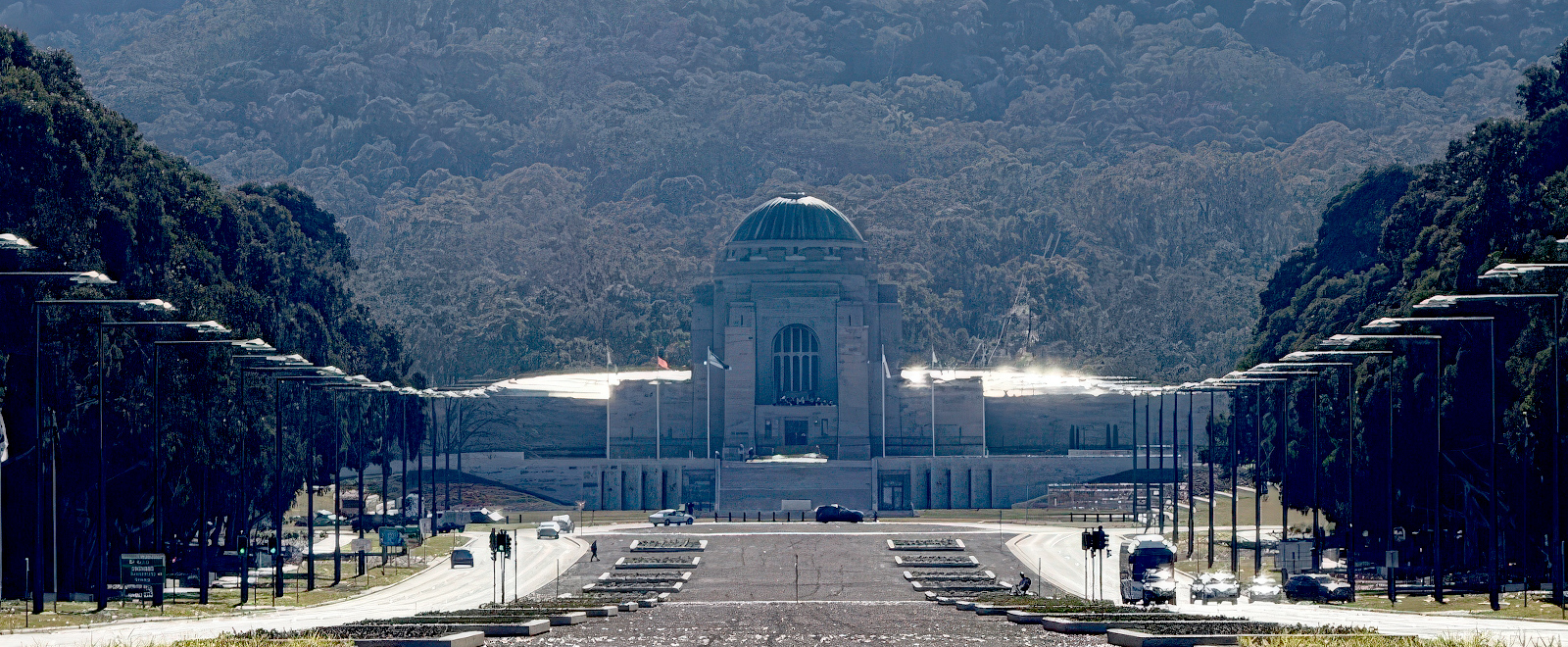
The Memorial from the south, early August 2025, showing the new Glazed Link roof appearing like sunlit wings behind the iconic dome (photo supplied).
Time to focus on the really big questions
A New Anzac mostly sidles away from those key questions, ‘Why were these wars fought? and ‘Were they worth it?’ Someone in episode 4 says ‘no war is good’ but the show moves on quickly. One staff member says that people should walk away from the Memorial with a lot of answers but bigger questions as well. It’s good to know that the Memorial’s people sometimes think that way, even if this big promo-doco puts much more effort into photography of big toys and large spaces and reverential opening and Anzac Day ceremonies than into deep questions.
We are told many times that the Memorial is about ‘stories’; it needs to be about reasons and implications as well. The closest we get to talking about hard stuff comes towards the end of episode 4, with discussion of a Kat Rae work on Afghanistan, a female army veteran reliving the difficulty of leaving Kurdish female fighters behind in Syria, and Director Anderson trying to balance complex issues to do with the Memorial’s future treatment of Brereton and Afghanistan.
Returning to the Australian Wars, here are some thoughts about repurposing the Memorial’s dedicated staff: get the folks who agonised over how much dirt was needed on a Timor Leste diorama to put the same effort into a diorama of the Appin Massacre of 1816, the Battle of One Tree Hill 1843 or Battle Mountain 1884; ask the technical wizards at the Treloar Centre to work up a replica of one of the structures built in the nineteenth century to withstand the attacks of First Nations warriors trying to repossess their stolen Country; have the staff who record the stories of recent veterans turn their efforts to the oral history of First Nations people whose ancestors were murdered or raped or poisoned by settler-invaders taking their land. That would really be a New Anzac.
* The Australian War Memorial Act 1980, sub-section 9(2) says: 'The Council is responsible for the conduct and control of the affairs of the Memorial and the policy of the Memorial with respect to any matters shall be determined by the Council'.
We welcome a response from the Memorial or Wildbear and will publish it without amendment, taking account of our Moderation Policy.
Picture credit: promo for the show used with permission Wildbear Entertainment. Thanks!
More from
General
category


